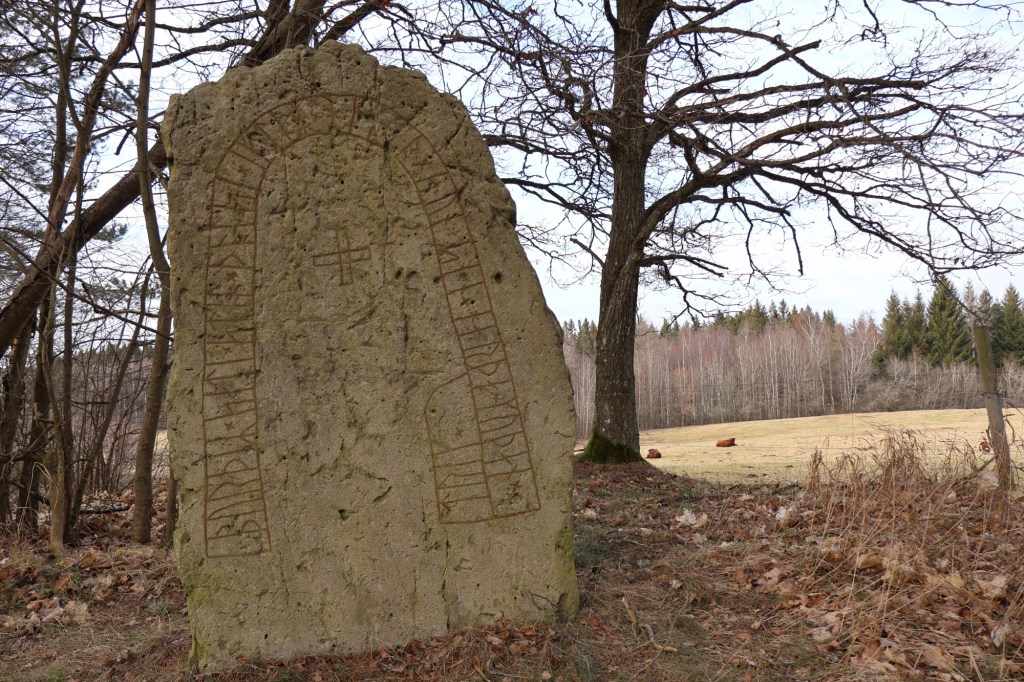
Just next to the road on a small ridge stands a rune stone popularly called Torestorpstenen. It goes by this name because it is located in Torestorp, Västergötland, Sweden. The name Torestorp is made up of Tore (a mans name) and torp which would translate to croft and are a Swedish word based on the old Norse þorp. The stone is also known as Vg 90.
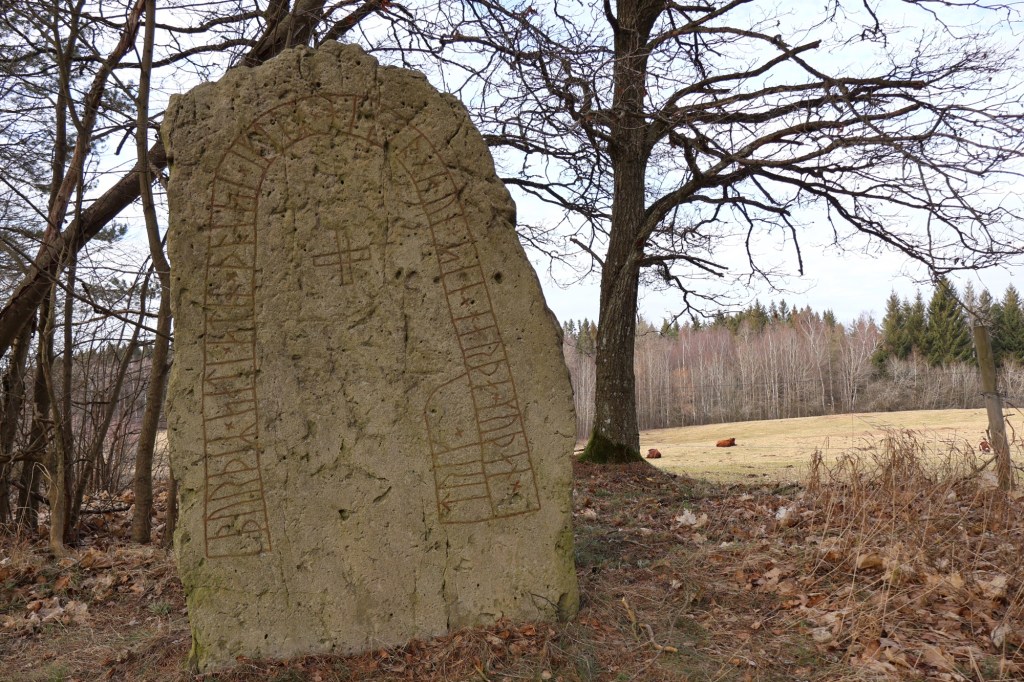
The Torestorp rune stone is the first rune stone in the world to be mentioned in a literary source, that we know of today. It is mentioned in a letter written 1287 by the Swedish King Magnus Ladulås (Barnlock) as a border marker between the village of Håkanstorp and the land owned by Gudhem Abbey that you can read more about my visit there HERE.
The stone is made of sandstone and measures 1,30 meters wide and 2,10 meters tall. Beside the runic inscription it is decorated with a very simplistic Christian cross, it’s simplistic compared to many other rune stones that I have observed.

The inscription reads:
burþiʀ • sati • stin • þonsi • iftiʀ • h(i)–o • sun • sin • harþa • kuþan • trik •
Broðiʀ satti stæin þannsi æftiʀ hi–o, sun sinn, harða goðan dræng.
Broðiʀ (Brother) placed this stone after Hi..o, his son, a very good young man.
Broðiʀ is an eastern Norse name that are still in use in Sweden but then as the modern Swedish word Bror that means brother. The person that wrote the runes made a mistake while writing the word Broðiʀ and he wrote Borðiʀ instead.

The cross and the inscription dates the rune stone to early 11th century.
Behind the stone there is a pit that someone in the past has dug. The pit is mentioned as early as 1742. It might be related to the local legend that is tied to the rune stone. According to the legend there is a king by the name Rundske buried in the mound that the stone is erected on. The stone is according to the legend raised in his name and the person that can read the runes will find the kings hidden treasure.
One day a a farmer got the idea that he would dig up the treasure. Every Thursday evening he went to Runhall (Rune Hall) and dug. On the third evening a giant appeared to him and gave him such a beating that he spat blood for a month. This legend was written down by a man known as H. Wranger in 1742 when he inspected the rune stone. He is the same man that speculated about the origin of the pit.

There might be some truth to it in my opinion, not that it was a giant that punished the farmer, but the stone was at some point found lying down and it was re erected in 1860 as it had been “omkullgrävd” which means that someone dug next to it so that it fell down. Is it possible that a farmer actually dug there after a treasure, but accidentally toppled the stone over hurting himself? Maybe he would rather make up a story about a giant beating him than admit that he was clumsy? I believe that many myths and legends have a grain of truth in them.
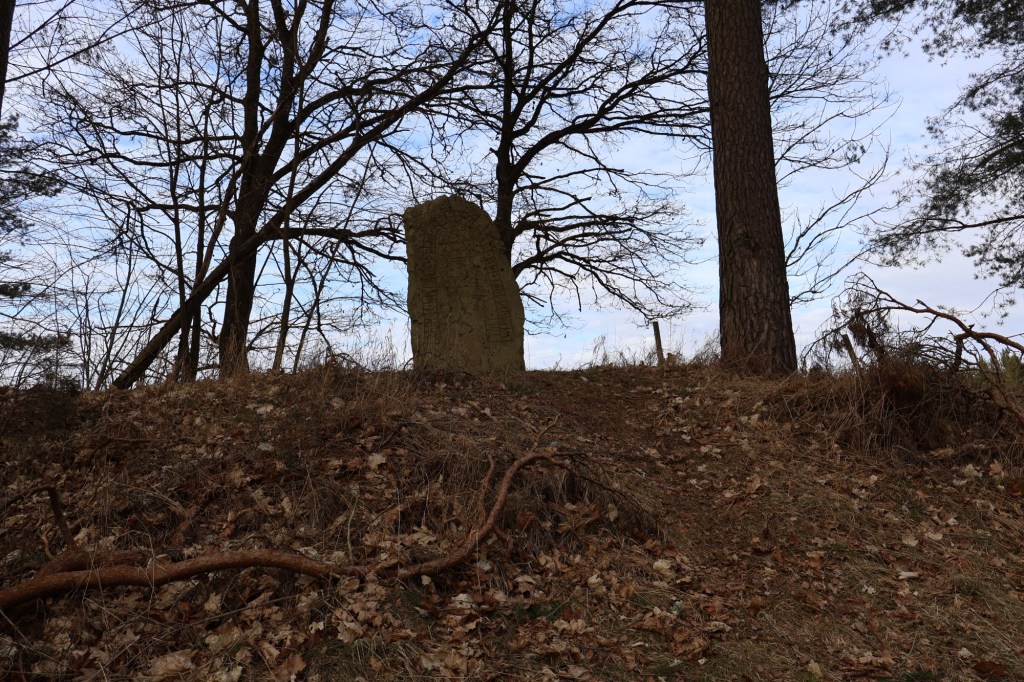
We do know however that the stone doesn’t mention a king Rundske or that he mound is his grave. Mostly because it isn’t a man made mound, but a natural ridge into which sides people have dug over the years to get sand and to build the road.
Close to the stone there is a hålväg, a type of ancient sunken lane.
 Fornminnen
Lämna en kommentar