
Some runestones are just much more interesting than others. Some of them have become famous because of it, but some have gained much less attention from the public. This is just such a runestone.

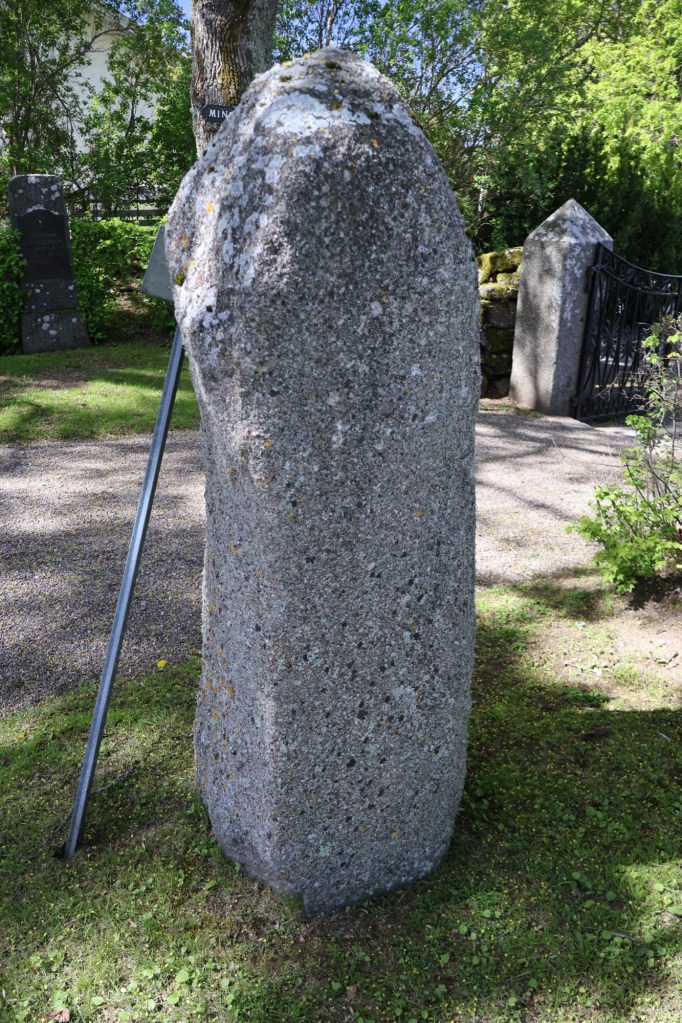
The Kälvesten runestone or Ög 8 as it is also known is erected in the graveyard at Västra-Stenby Church in the province of Östergötland, Sweden. Thats not far from one of the world’s most famous runestones Rökstenen. There’s a similarity between these two stones in that they are both written using younger Futhark short twig runes. These are typical for the early Viking Age. The Kälvesten runestone is dated to the 9th century by most sources even if I have read estimates that it was younger and made between 980 and 1015, but I can’t find any information why such a late date would be appropriate.

The stone measures 1,6 m high and 50 cm wide and it has runes on two sides but it is otherwise plain.
It was first discovered in the wall of Kälvesten church in the 17th century. This church was demolished between 1811-1812 when the two parishes of Kälvesten and Sten was incorporated in each other forming the parish of Västra Stenby. The runestone was again used as building material in the construction of the new church. In 1938 the stone was removed from the wall and erected in the graveyard. It wasn’t until 1942 that experts realized that there was runes on two sides of the stone.

The inscription reads:
Side A: stikuʀ (‘) karþi kubl þ(a)^(u) aft auint sunu sin ‘ sa fial austr
Side B: miʀ aiuisli ‘ uikikʀ faþi auk| |krimulfʀ
Side A: Stigr/Styggr made these monuments in memory of Eyvindr, his son. He fell in the east
Side B: with Eivísl. Víkingr carved and Grímulfr.
So this is a monument erected by a father called Stigr/Styggr to honor a son Eyvindr that died in the East. This refers most likely to a trip to either the Baltic coast or on the rivers of Russia. This is the first written account in Sweden of anyone traveling to the East.

The other side starts: with Eivísl. This name is extremely rare it occurs only in two written sources in the entire corpus of Germanic language text. This stone in Östergötland and the second source is the famous runestone Sparlösastenen in Västergötland.
The part of the inskription on Sparlösastenen that is relevant here reads:
Side A: a⁑iuls kaf ⁓ airikis sunʀ kaf alrik- –
Side B: —t—la kaf rau- at kialt(i) · …a sa- faþiʀ ubsal faþiʀ suaþ a-a-u–ba …-omas notu auk takaʀ ⁓ aslriku lu–ʀ ukþ-t a(i)u(i)sl
Side C: …s—n(u)(ʀ)-a– þat sikmar aiti makuʀ airikis makin(i)aru þuno · aft aiuis uk raþ runoʀ þaʀ raki-ukutu iu þar suaþ aliriku lu(b)u faþi ‘
Side A: Eivísl, Eiríkr’s son gave, Alríkr gave …
Side B: … gave … as payment. Then(?) the father sat(?) (in) Uppsala(?), the father that … nights and days. Alríkr <lu–r> feared(?) not Eivísl.
Side C: … that Eiríkr’s boy is called Sigmarr/celebrated-for-victories. Mighty battle(?) … in memory of Eivísl. And interpret the runes of divine origin there …, that Alríkr <lubu> carved.

So the text on this stone also speaks of someone named Eivísl that is the son of Eiríkr had some sort of relationship to someone named Alríkr that erected the stone over Eivísl. Eivísl is obviously dead because he got this stone in his memory. From what we can read he was a warrior that was victorious.
So now one might think why this focus on another runestone just because they share the name Eivísl? The reason is that there is a theory partly based on the rarity of the name and the fact that both stones seem to be similar in age using the same type of short twig runes.
Eivísl on our stone is possibly the same person as on Sparlösastenen. According to this theory the both stones speak of the same events, an expedition headed by Eivísl to the east. From the informationen on Sparlösastenen it is postble that this expedition was financed by a man named Alríkr <lubu> that was a influencal man among the Geats. (More about him in the future post about Sparlösastenen.)
When the expedition failed, Eivísl died and with him at least one of his men Eyvindr fell.
Alríkr <lubu> made an elaborate stone in memory of the leader and Stigr/Styggr ordered a simpler one for his son.
But Stigr/Styggr didn’t carve the Kälvesten runestone himself. We can read that the stone was carved by someone named Víkingr and he had help from someone named Grímulfr.
In this context Víkingr is used as a personal name and not in the more common way as an activity.
 Fornminnen
Lämna en kommentar