Järsbergsstenen (the Järsberg stone) are a rune stone located just outside of the small Swedish town of Kristinehamn. It’s one of only four known rune stones in the province of Värmland. The province has relatively few rune stones compared to some other Swedish provinces. But this stone is one of the more interesting ones in my opinion.

It is not like most rune stones dated to the Viking Age, but it is far older than that. It was created some time during the 6th century and the runes used are from the elder futhark, an older set of runes than the more well known younger futhark used during the Viking Age.
The language used by the writer is Proto-Germanic the language spoken here in Scandinavia that would eventually evolve into old Norse and the modern languages of Swedish, Norwegian, Danish and other European languages.
The inscription reads: ᚢᛒᚨᛉ ᚺᛁᛏᛖ ᛬ ᚺᚨᚱᚨᛒᚨᚾᚨᛉ ᚺᚨᛁᛏ ᛖᚲ ᛖᚱᛁᛚᚨᛉ ᚱᚢᚾᛟᛉ ᚹᚨᚱᛁᛏᚢ
Transliteration into Proto-Germanic: ubaz hite h^arabana^z h^ait… ek e^rilaz runoz waritu
In English it says: Leubaz am I called. Hrafn am I called. I, the eril, write the runes.
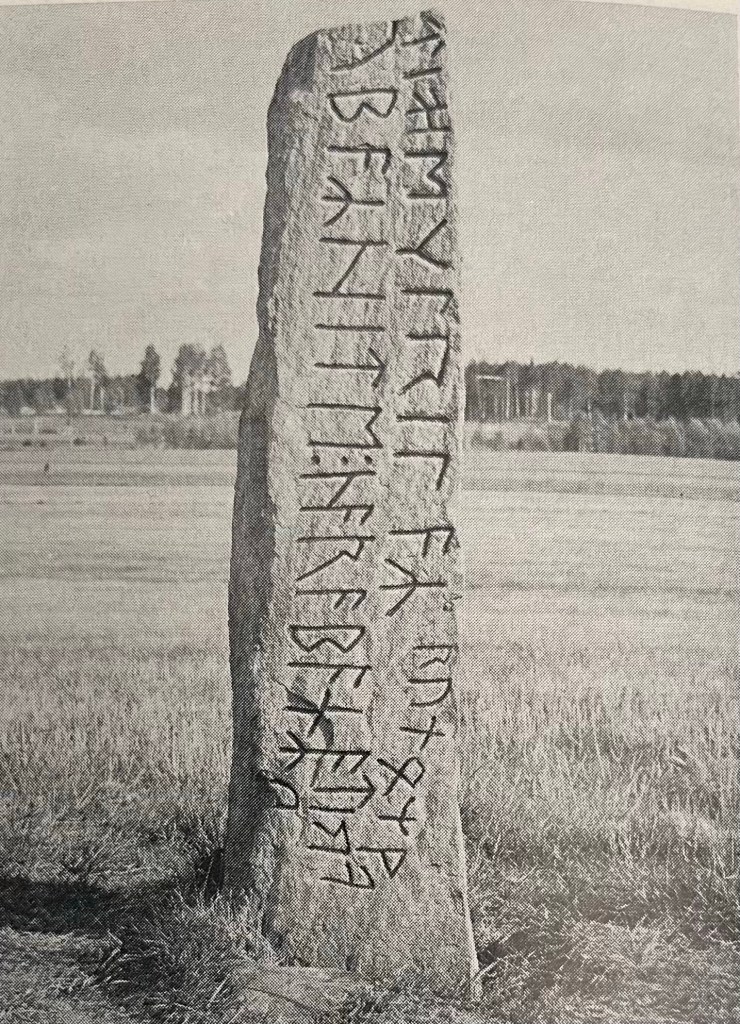
Many people have tried to interpret the meaning of the text and the theories are varied.
A old interpretation has to do with the name or title Eril. There are several runes stones in modern day Sweden that mentions this word, they are therefore called Eril stones. The theory said that Eril was a version of the word Herul or Heruli which is a Germanic people that existed during the migration period.
According to the Roman scholar Jordanes in his work Getica claimed that the Heruli migrated from their home in southern Scandinavia before making their way through Europe making wars typical of the period.
Another Roman scholar Procopius wrote that in 508 the Heruli was defeated in a battle with the Lombards in northern Italy. He wrote that a group of Heruli nobles and royalty after the defeat in 512 travelled north through the lands of the Slavs and Danes to settle in Thule (Scandinavia) next to a people he calls Geats.
The Geats are thought to be Götar, the name of the people that lived in the provinces of Västergötland, Östergötland and Dalsland. Värmland were our rune stone is situated are located next to two of these provinces and it was created during the same century as this return home is supposed to have happened.
Some think that when the noble Heruli disappeared being integrated with the locals, that their name Eril was remembered and evolved into the later title Jarl that was used in Scandinavia into the medieval period. The last person to use the title in Sweden was Birger Jarl (1248–1266).
So is this a possible theory? Maybe, but it is important to question the old Roman sources. I read an article a few years ago with a current scholar that believed that there is a lot of truth in these stories, but he placed their final destination of their settlement as the neighboring province of Dalsland.
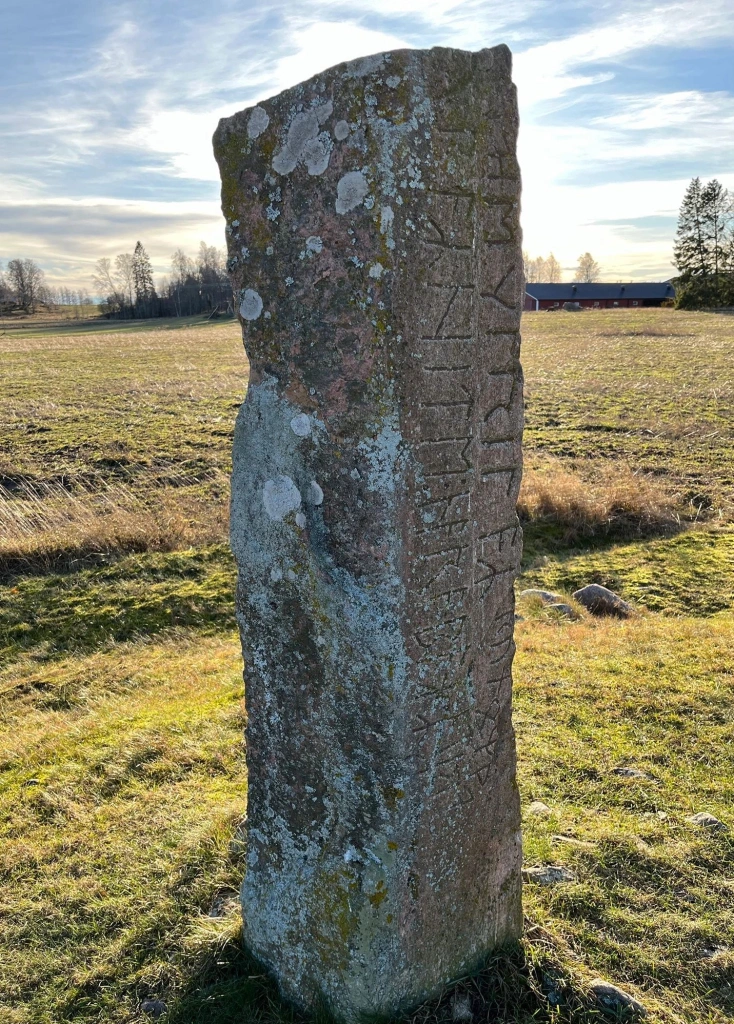
The inscription mentions a couple of people Leubaz (pleasant), Hrafn (Raven) and the creator Eril. These people are the first people in history from Värmland whom we know the name of.
There are also other interpretations that the runes should be read in a different order. The text should then be read:
Ek, erilaʀ, [Le]ubaʀ(?) haite. Hrabnaʀ hait[eka], runoʀ writu.
”I, Eril, called Plesant. Ravn is my name, who writes the runes.”
This interpretation is considered by the Swedish National Heritage Board as the more likely one.
The rune stone is made out a reddish granite and it was found 1862, in its current location. It was then partially buried. The person that found it wanted to use it as a gatepost before he saw the runes. It was then erected at its original place.
The top of the stone is missing and it was already gone when it was found. It is likely that only a few runes are missing and they shouldn’t change the interpretation much.

The stone is placed on top of a small mound that may or may not be a grave mound. In 1975 an archeological dig was carried out and no human remains were found or other objects.
The archeologist noted however that the profile of the hill looked like a typical grave mound. In 1987 archeologists found a glass pearl typical of female prehistorical graves.
There is a grave field not far from the stone that was discovered in the 1980s.
According to old sources there was once eight more stones erected around the mound making it an impressive sight for passers by. The other eight stones have disappeared due to destructive farming activities at the site.
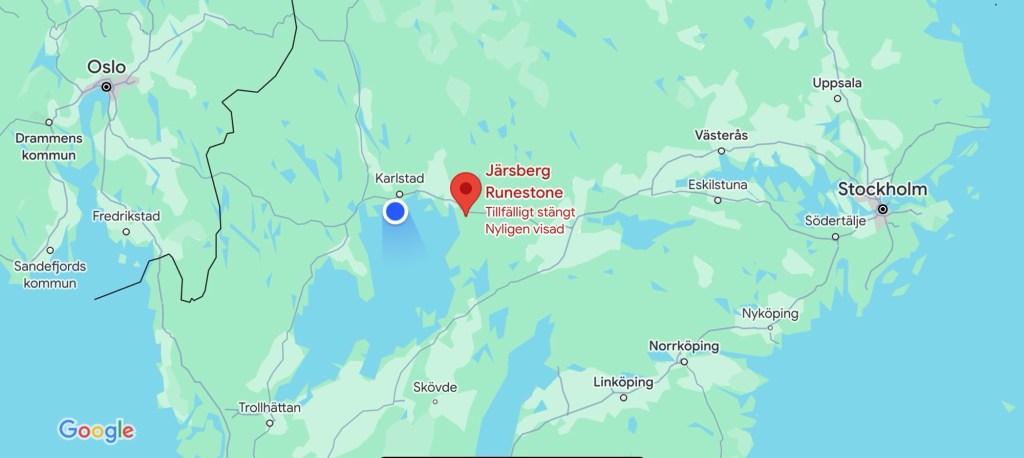
The location of this site is not random. It is just next to Letstigen a road that once connected Mälardalen the heartland of Svitjod (the kingdom of Swear) and Vestfold, a province in Norway. How old this road really is, are unknown. But along it in Värmland there are two rune stones along it, the other one are Väsestenen, a Viking Age rune stone, that I might write about in the future. It is known that during the medieval period the road was also used as a pilgrim trail.


 Fornminnen
Lämna en kommentar